
How to quit sports betting
Quitting sports betting comes down to two jobs: make a bet harder to place than the urge is long, and replace what betting was doing for you. The steps below are in the order that tends to work, starting with the ones that take ten minutes. You can do every one of them without an app. Void helps with some of them, and this page says which.
Updated October 20, 2026 · Checked against Void 1.1.5
1. Decide: cut back or quit
Pick one and say it to someone. “Less” is not a goal a Tuesday night can hold you to; “no bets until the first of the month” or “no bets, full stop” is. If you have already tried to cut back more than twice, the honest reading is that cutting back is the harder of the two for you, because every bet reopens the decision.
In Void you choose either goal at setup. Cut back sets a quit date; blocking is on from day one either way, and on the date the app moves to quit mode, where the streak becomes the number that matters.
2. Self-exclude, today
Every licensed US sportsbook has a self-exclusion option in its Responsible Gaming settings, and most states that allow online betting run a list that covers every operator in the state at once, for one to five years or for life. It takes about ten minutes per book. Do it before step 3, because once the apps are blocked you will not want to open them to find the setting.
The National Council on Problem Gambling keeps a state-by-state directory at ncpgambling.org. Offshore and sweepstakes sites have no such list, which is what the next step is for.
3. Close the access
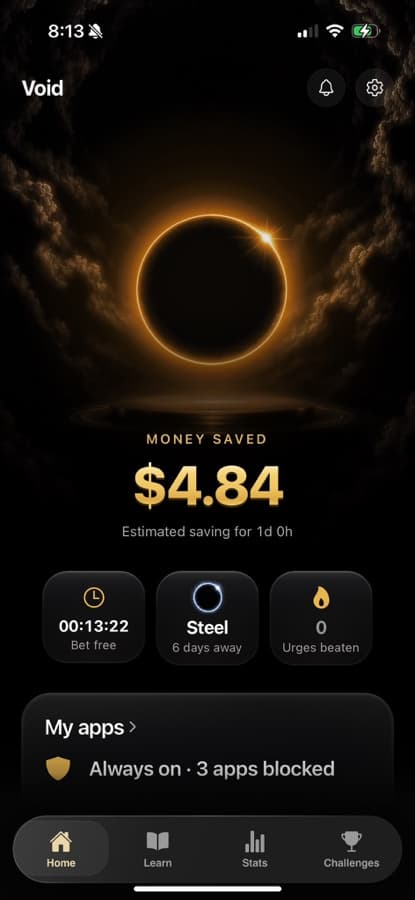
Delete the sportsbook apps, then block them so they cannot come back in thirty seconds. On an iPhone that is Apple's Screen Time, either set up by hand or through Void, which runs its blocking on Screen Time and adds a filter for more than 340,000 betting domains. The step-by-step is on the how to block gambling apps on iPhone page.
Unfollow the picks accounts, mute the group chat where the slips get posted, and turn off the sports-app notifications that read like odds. None of this is dramatic. All of it removes a tap.
4. Cut the money off
- Remove saved cards and bank links from every betting account before you close it.
- Ask your bank or card issuer whether it offers a gambling-transaction block. Several do, and the ones that do usually add a cooling-off period before it can be lifted.
- If you have borrowed to bet, write down the total today. Most people have not, and the number is the thing that finally makes the decision hold.
- If someone you trust can hold your main card for a month, let them.
5. Add up what it was costing
In a five-year study of 717,724 online gamblers across 32 states by researchers at UC San Diego's Rady School of Management, 96% appeared to lose money (the study). In U.S. News & World Report's 2025 survey of 1,200 US adults who had bet on sports in the previous six months, one in four had missed a bill because of betting and 30% had debt tied to it (the survey). The point of both figures is not that you are unlucky; it is that the product is built to come out ahead, and the only way to see your own number is to add it up.
Void asks for that number at setup, shows it as Lost So Far, and from then on runs a Money Saved estimate: the daily loss rate you reported, multiplied by the days since you started, minus any bets you log. It is an estimate, not money returned to you, and a logged bet takes it down. That is deliberate. A number that only ever went up would be a story, not a figure.
6. Plan for the urges before they come
Urges rise, peak and fade on their own if you do not act on them, usually within half an hour. The work is knowing what you will do in those minutes before they arrive: who you text, where you put the phone, what you do with your hands. The gambling urges page is that plan, and it explains how Void's panic button runs it in ten minutes.
Know your triggers by name. For most sports bettors they are a game being on, friends betting, payday, trying to win it back, and boredom. Void asks which one is pulling every time you hit the panic button, so after a few weeks you can see your own pattern.
7. Replace the game, not just the bet
Watching sports without money on it is flat at first; that is the dopamine arithmetic, not a sign you have lost interest in sports. Give it a month. In the meantime put something else on the clock: the gym, a side project, a book, sleep. Void's crew challenges run on exactly that, one week, one goal each, with friends, and proof logged every day.
8. Tell one person, and check in every night
Secrecy is the condition betting needs. One person who knows, and who you answer to, changes the odds more than any app. Void's version is a nightly notification: “Did you bet today?”, answered with one tap, so the money figure stays honest and the streak is a real count.
9. Get help if it is beyond self-help
If you have borrowed to bet, hidden losses from someone close to you, chased losses, or tried to stop and could not, use the help that exists alongside anything on this page. The National Problem Gambling Helpline is free and confidential: call or text 1-800-MY-RESET (1-800-697-3738), or chat at ncpgambling.org. Counselling for gambling, usually cognitive behavioural therapy, and Gamblers Anonymous meetings are listed there by state. Void is a self-help tool, not treatment, and it lists these same numbers inside the app.
Where Void fits. Steps 3, 5, 6, 7 and 8 are what the app does: blocking through Screen Time, the Money Saved estimate, the panic button, crew challenges, and the nightly check-in. Steps 1, 2, 4 and 9 are yours. The app is on the App Store.
Common questions
- Do I have to quit completely, or can I cut back?
- Both are legitimate goals, and Void supports both. If you choose to cut back, you set a quit date, blocking is on from day one, and on that date the app moves to quit mode. Many people find cutting back harder than stopping, because every bet reopens the question. If you have tried to cut back more than twice, treat that as information.
- What happens if I bet after I have quit?
- Log it. One bet is a slip, not a reset of everything you have done. In Void, a logged bet comes straight off the Money Saved estimate, the bet-free clock starts again, and the nightly check-in keeps asking. The number that matters is how fast you get back to not betting, not whether you were perfect.
- Is Money Saved real money?
- No. It is an estimate: the loss rate you reported when you set up Void, multiplied by the days since you started, minus any losses you have logged. It is there to make the cost visible. It is not money returned to you, and it never goes below zero.
- How long until the urges stop?
- They get rarer and shorter rather than stopping on a date. Most people notice the first clear change within a few weeks of being bet-free, with spikes around the triggers they always had: a big game, payday, friends betting, a late night. The gambling urges page covers what to do in the moment.
- When is this beyond self-help?
- If you have borrowed, hidden losses from someone close to you, bet to win back money, or tried to stop and could not, talk to a person as well as using an app. The National Problem Gambling Helpline (1-800-MY-RESET) is free and confidential, and the NCPG site lists counsellors and Gamblers Anonymous meetings by state.
Void is on the App Store
Made for iPhone. Blocking runs through Apple's Screen Time on your own phone; Void never sees which apps you choose.
Void Pro is $9.99 a month or $59.99 a year, with a 7-day free trial on the annual plan. Billed by Apple; cancel any time in your iPhone's Settings.
Read next
How to block gambling apps on iPhone
Screen Time on its own, or Void on top of it. The exact steps, what gets blocked, and what you can switch off.
Read the guide →
What to do with a gambling urge
What works in the first ten minutes, why urges pass on their own, and how Void's panic button runs it.
Read the guide →
If you need help right now
Free, confidential, and open 24/7. You don't have to be in crisis to use any of these.
- Call 1-800-MY-RESETNational Problem Gambling Helpline · 1-800-697-3738
- Text the helpline1-800-697-3738 or 1-800-522-4700 — no call needed
- Chat with a counsellorIn your browser, 24/7
- Call or text 988Suicide & Crisis Lifeline
- Text HOME to 741741Crisis Text Line
These are independent organisations. Void receives nothing for listing them and never shares your information with them.